 I AM NOT A HUMAN
Visitor signs in No, I’m Not a Human
Treat a sign as evidence to weigh. Red eyes are the publisher’s example of a clue that can appear in ordinary people too.
Spoiler-free. The examples leave out guest identities and ending outcomes.
Three kinds of evidence
A conversation, an inspection and your own inference answer different questions. Keep track of where each detail came from before you compare them.
- What they said
- Record the claim in one sentence. A detail such as where they came from gives you something concrete to compare with what you learn later.
- What you saw
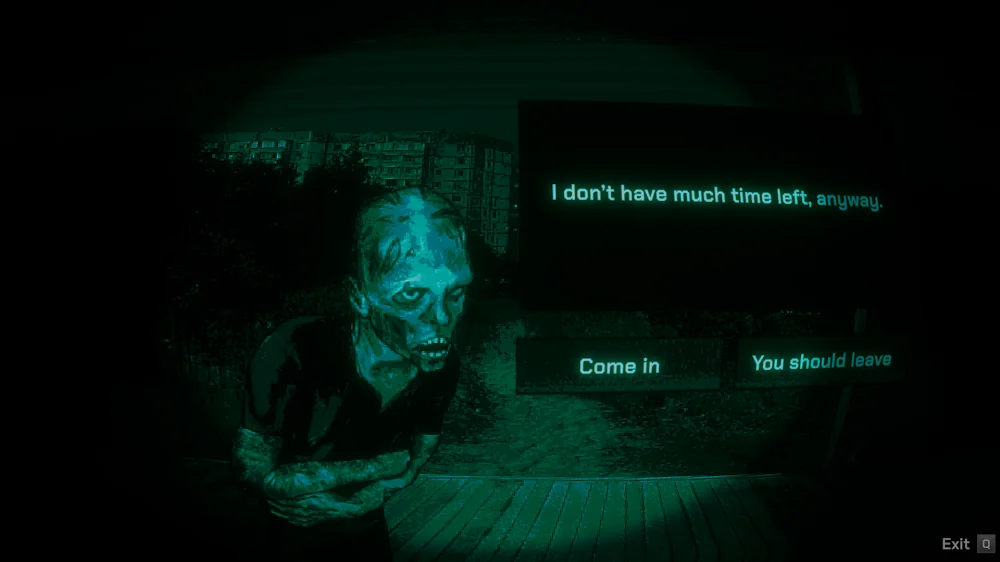
- Describe the appearance before giving it a meaning. Red eyes tell you what you saw during that check. Ask how much the appearance changes your confidence.
- What you inferred
- Write down why you suspect a Visitor and which part is still uncertain. When new information arrives, you can see exactly which assumption it changes.
The publisher describes ambiguous physical signs, variation between playthroughs and outcomes shaped by decisions. Read the developer and publisher overview.
Practice reading a clue
These fictional cases show reasoning you can take into a run. Open each one to compare with your first instinct.
A quiet guest has red eyes
Write down the eye appearance as the observation. The quiet voice is a separate impression. Ask whether either detail rules out an ordinary person. The publisher’s red-eye example gives you a reason to leave that possibility open.
A guest repeats the same account
It may be useful that the account stays consistent. Both statements came from the same person, so count the repeated detail as one claim. If an independent observation comes up later, compare it with that claim.
You remember this face from a previous run
Write down what you observed in this run. The publisher describes randomization across playthroughs, so your memory of a past encounter is a starting point for a question. Give the current conversation and any available inspection their own place in your notes.
When the next check could help
Pick the guest you are most unsure about. Decide what new information would change your mind. If the game gives you an opportunity to look for it, compare the result with your earlier observation before acting.
If the result leaves you with the same two possibilities, write down what remains uncertain. That gives you something specific to revisit in a later conversation or in another run.